LITHIUM BATTERY RECYCLING / MANUFACTURER EVALUATION
Top Lithium Battery Recycling Machine Manufacturers in 2026
Evaluate LOSUN Machinery through production-line systems, stated product specifications, verifiable delivery records, comparable projects and contract-defined after-sales support.
Estimated reading time: 8 min
QUICK ANSWER
How should buyers assess a lithium battery recycling machine manufacturer in 2026?
Assess technical capabilities, product performance, market reputation, comparable projects and after-sales service. Drawings, tests, delivery records, project boundaries and service agreements provide the evidence needed to evaluate a manufacturer against a defined project.
With rapid advances in new energy vehicles and the energy storage industry, large quantities of traction batteries, energy storage batteries and consumer electronics products are being retired in large batches. The volumes of production offcuts and rejected cells generated during battery manufacturing are rising sharply. Resource recovery, reuse and harmless treatment of lithium batteries are entering a new stage of rapid development. In 2026, new environmental requirements, upgrades in precision separation technology and increases in capacity are being implemented across the industry. The technological capabilities and capacity scale of lithium battery recycling machines have become important indicators of resource recycling capability. A top lithium battery recycling machine manufacturer in 2026—LOSUN Machinery. Today, we analyze five areas in detail: technical capabilities, product performance, market reputation, cooperation projects and after-sales service.
Advanced Core Production Line Systems
Enclosed Feeding and Crushing System
This system feeds retired batteries of different sizes uniformly and continuously to the crushing stage. A variable-frequency, speed-controlled feeding device adjusts the feed rate to match the real-time processing capacity of the downstream crushing and separation stages. This prevents material blockages caused by feeding too quickly and idle running caused by feeding too slowly. The feeding system and crushing chamber are fully enclosed. An inert gas protection system is provided throughout the process.
Pyrolysis and Cooling System
Battery fragments that have been thoroughly dispersed are conveyed uniformly into the pyrolysis furnace through a variable-frequency, speed-controlled screw conveyor for complete pyrolysis. The conveying speed in the cooling stage is adjusted according to the temperature of the pyrolyzed material, ensuring a stable material temperature at entry to the multi-stage separation stage.
Multi-Stage Separation and Powder Removal System
The system integrates airflow separation, air separation, two-stage high-intensity magnetic separation, gravity separation, flexible powder removal and other stages. The processing capacity of each stage is calibrated to the design capacity of the complete line. Internal flow-control valves keep the separation of copper, aluminum and Black Mass within a stable rate range. As the main product-output stage of the line, its processing-rate stability directly determines the recovery rates and purity of the finished products.
High-Efficiency Gas Purification System
The system handles dust and exhaust gases generated at each stage using a variable-frequency fan system. The extraction rate is adjusted to the amount of dust generated at each stage. This maintains negative pressure throughout the stages while preventing excessive airflow from carrying away recoverable materials. Environmental treatment equipment can be configured to the standards required in different countries and regions.
Efficient Processing Capacity and High-Quality Finished Products
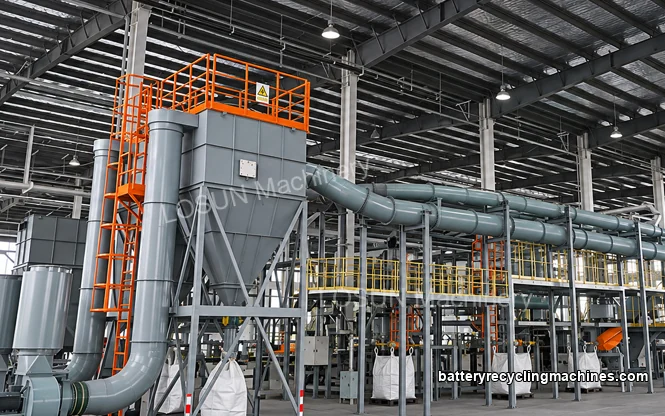
The 2026 next-generation lithium battery recycling machine integrates eight core processes—feeding and conveying, intelligent dismantling, charged battery crushing, oxygen-free pyrolysis, multi-stage precision separation, material purification, exhaust gas dust removal and finished-product collection—into a complete modular and integrated recycling line. The processing capacity of a single lithium battery recycling production line is flexible and controllable. It requires neither the piecing together of multiple equipment units nor intermediate transfer and handling, providing one-stop resource recovery for waste lithium batteries. It can maintain stable processing at 1,500–2,000 kg per hour. This meets the production needs of small and medium-sized enterprises and can also be adapted to large industrial park recycling projects at the 10,000-tonne scale.
The line is compatible with a range of feedstocks, including NMC, LCO and LFP. It automatically adapts to the processing requirements of different materials. The finished products are of high quality and can meet the standards required for downstream hydrometallurgical purification.
| Finished Product | Purity | Recovery Rate |
|---|---|---|
| Black Mass | ≥98% | ≥98% |
| Copper | ≥98% | ≥96% |
| Aluminum | ≥96% | ≥92% |
| Steel Casings | ≥98% | ≥98% |
Market Reputation: Use Fulfillment Records and Issue Resolution as Evidence
Industrial equipment reputations are often formed through actual work after delivery: whether the drawings match the equipment, whether on-site interfaces are clear, whether commissioning issues can be diagnosed, and whether spare parts and technical documents are easy to use.
We do not treat application examples, equipment reference images or videos, or promotional reviews as evidence of customer operation. To assess the quality of cooperation, review records that can be linked to the same order, such as technical change records, factory inspections, delivery documents, on-site issue lists and their closure status.
With customer authorization, follow-up visits to lithium battery recycling projects can also help you understand:
- Whether the actual feedstock matches the contract conditions;
- What issues arose during commissioning and how they were resolved;
- What personnel and tools are required for routine maintenance;
- Whether fault communication is accurate and the handling process is documented.
Currently, this article does not list unverified satisfaction figures, repeat-purchase rates or industry rankings. For us, market credibility should be supported by verifiable fulfillment performance, with project limitations and improvement items stated accurately.
Cooperation Projects: Compare Similar Operating Conditions, Not Just Project Counts
The reference value of a cooperation project depends on how closely it matches your planned project. Feedstock being classified as “lithium batteries” does not mean that the processing task is the same.
We recommend screening project documentation against the following conditions:
| Project Condition | Information the Case Should State |
|---|---|
| Chemistry | LFP, NMC or another agreed chemistry |
| Incoming Feedstock Form | Battery packs, modules, cells, electrode sheets or shredded material |
| Processing Scope | Boundaries of front-end pretreatment, physical and mechanical processing, and subsequent stages |
| Product Requirements | Delivery specifications for Black Mass and metal fractions |
| Operating Conditions | Shifts, utilities and on-site organization |
| Basis for Results | Commissioning, test or acceptance records |
When presenting lithium battery recycling plants, we should distinguish design capacity from measured results and equipment reference images from project-site photographs. Projects that do not disclose customer names or operating data should also state the scope of the available documentation. Speculative performance records must not be added.
A more useful case is one that explains feedstock compatibility, engineering adjustments and delivery outcomes. Country names, equipment photographs and rated capacity alone are still insufficient to judge actual operating performance.
After-Sales Service: Document Fault Diagnosis, Maintenance and Spare-Parts Supply
After-sales work does not take place only after equipment fails. The completeness of installation documents, whether job-specific training covers actual operation, and whether wear-part specifications are clear all affect maintenance efficiency after commissioning.
We can arrange installation guidance, commissioning, operator training, spare parts and remote technical support within the contract scope. Service responsibilities and durations are governed by the commercial agreement.
For fault handling, we place importance on complete information. Equipment numbers, alarm records, operating conditions at the time of the fault, trend data and on-site images help distinguish mechanical, electrical, control-system and feedstock issues. Repeated resets before the cause is confirmed may worsen the fault or conceal the problem.
The service agreement should specify:
- The scope of remote and on-site support;
- Fault-reporting channels and responsible points of contact;
- The start date, coverage and exclusions of the warranty;
- Wear-parts lists, ordering information and supply arrangements;
- Services and charges outside the warranty scope;
- Records of software, drawings and equipment changes.
Response time and recovery time should also be understood separately. Promptly receiving a reported problem does not mean that every fault can be resolved within a fixed period. We recommend defining service arrangements according to fault severity, spare-parts availability and the scope of on-site work.
06 / FAQ
FAQ: Procurement Questions about LOSUN Machinery
1. Is LOSUN Machinery a “top manufacturer in 2026”?
“Top” requires clear, independent evaluation criteria. This article does not present rankings without sources as a conclusion. We recommend assessing suitability for your project through factory inspections, technical documents, testing and delivery records.
2. How can you verify our manufacturing and quality management?
You can discuss a factory visit or video inspection and review relevant drawings, equipment lists, inspection plans and available test documentation for the order. The verification should correspond to the equipment being considered for purchase.
3. Can publicly stated capacity be used directly as a contractual specification?
It should not be copied directly. We first need to confirm feedstock, process scope, product requirements and test methods, and then agree on enforceable acceptance conditions.
4. Does holding a certificate mean that a complete line is suitable for every project?
No. The certificate holder, product scope, standards, issuing body and validity must be checked. Component documents cannot automatically serve as compliance evidence for the complete line or factory.
5. Can you provide projects comparable to ours?
You can submit your feedstock, capacity, product and regional requirements so that we can discuss the relevant documentation available. Disclosure of customer identities and operating data, as well as site visits, must remain within the authorized scope.
6. Does after-sales service include free on-site service and all spare parts?
The contract governs the scope. Installation and commissioning, warranty work, wear parts and subsequent technical services should be specified separately to avoid interpreting technical support as indefinite free supply.
7. What should we prepare for the first technical discussion?
Please provide the source and condition of the feedstock, representative sample information, annual processing plans, target products and factory conditions. We use this information to identify the issues that require verification before discussing configuration and quotations.
At LOSUN Machinery, we want you to be able to verify not only equipment specifications, but also their supporting evidence, manufacturing records, project boundaries and service responsibilities. Purchasing decisions should be based on these specific records.
