
SOLAR PANEL RECYCLING / MANUFACTURER EVALUATION
How to Choose a Solar Panel Recycling Machine Manufacturer
Learn how to evaluate solar panel recycling machine manufacturers across engineering teams, manufacturing processes, pilot test records, quality traceability, and project services to verify true fulfillment capability.
Estimated reading time: 8 min
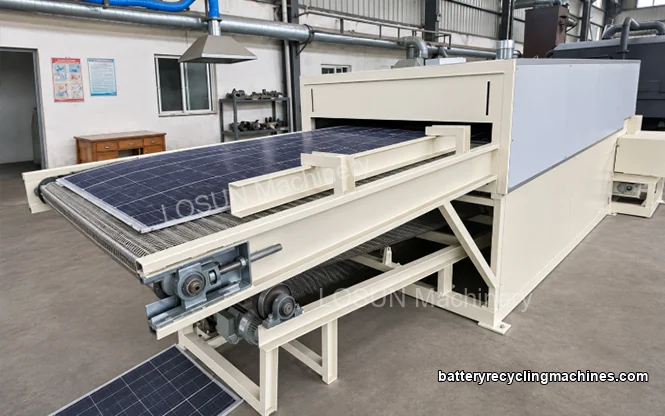
Selecting a solar panel recycling machine manufacturer requires evaluating far more than whether the equipment simply runs. You must also assess whether the process fits your feedstock, whether individual stages integrate smoothly, and whether you will receive reliable technical support if issues arise after delivery.
At LOSUN Machinery, we recommend focusing your evaluation on five core areas: core process and equipment integration, manufacturing and testing facilities, engineering team capability, after-sales response, and proven case studies with client reputation. These factors should be verified through site inspections, documentation reviews, and direct technical discussions—never based on marketing brochures alone.
1. Core Process & Equipment Integration: Verify End-to-End Production Capability
Solar panel recycling involves deframing, junction box removal, glass separation, and downstream material processing. Smooth operation of a standalone machine does not guarantee that an entire line is capable of continuous industrial production.
First, verify the alignment between the process and your feedstock: Are different panel types processed the same way? How do shattered modules enter the system? Where do separated glass, laminates, and fine powders go? Every stage must have a clearly defined function—equipment count alone does not prove process completeness.
Equipment integration is reflected in mechanical interfaces and electrical controls. Feeding/discharge rates, conveyor elevations, processing loads, and startup/shutdown sequences between adjacent units must match. The engineering design should also clearly specify how upstream feeding halts and how auxiliary systems maintain safe operation if a downstream station jams or stops.
We recommend requesting the following documentation from the manufacturer:
| Verification Document | Key Evaluation Criteria |
|---|---|
| Process Flow & Mass Balance Diagram | Whether the processing pathway for every material stream is clearly defined |
| Equipment Load & Interface Specifications | Whether upstream and downstream capacities and physical interfaces match |
| Control & Interlock Descriptions | Whether abnormal conditions and faults trigger coordinated safety responses |
| Product Assay & Pilot Test Records | Whether the process meets contracted separation and purity targets |
More importantly, assess whether the manufacturer can clearly explain the interdependencies between stages and how modifying one unit impacts the entire production line.
2. On-Site Inspection of Manufacturing & Testing Facilities: Evaluate Production and Trial Conditions
A factory audit should focus specifically on the equipment you intend to purchase. Workshop size and floor layout reflect basic infrastructure, but they cannot replace direct inspection of fabrication, assembly, quality control, and testing workflows.
Schedule a structured inspection agenda covering raw material preparation, machining and fabrication, mechanical assembly, electrical installation, and factory acceptance testing (FAT). For critical components, cross-check engineering drawings, material specifications, and QA inspection records to confirm that workshop execution matches the technical proposal.
At the testing facility, verify whether it is equipped to process your specific feedstock. Standalone machine trials, partial-process runs, and full-line integrated tests prove very different things. If you only observe a single machine running, ask what systems handle its upstream and downstream stages—and pay close attention to operational stability, noise levels, and dust containment.
During feedstock trials, verify module identification, sampling and weighing protocols, and whether finished products, recirculated middlings, and residues are logged separately. Inspect the purity of the resulting glass cullet, silicon powder, copper granules, and plastic fractions firsthand. Test results must be traceable to an exact equipment configuration rather than relying on an unverified lab report with no feedstock details.
If an on-site visit is not feasible, arrange a live video inspection or a third-party audit. Specify in advance which machines, operating sequences, and records you want to review to avoid the limitations of pre-recorded promotional videos.
3. Technical Team: Evaluate Who Solves Problems and Executes the Design
The true strength of an engineering team becomes evident during technical discussions.
Bring practical operational questions to the table—for example: How should production be organized for mixed feedstocks? What should be inspected if polymer residue on separated glass runs high? Which mechanical assemblies and parameters require adjustment when panel dimensions change? Credible answers will explain root causes, required data inputs, and concrete verification methods.
Additionally, clarify who is responsible for process engineering, mechanical design, electrical controls, and on-site commissioning. Whether the engineers who design the initial proposal remain involved in manufacturing verification and commissioning troubleshooting directly impacts project execution.
Pay particular attention to three critical handoffs:
Testing to Design: Whether findings from pilot trials are translated into structural or parameter refinements.
Design to Manufacturing: Whether drawing revisions are synchronized across procurement, assembly, and control documentation.
Manufacturing to Site: Whether installation and commissioning engineers fully understand design assumptions and operating limits.
Headcount alone does not indicate technical depth. Check whether engineers are intimately familiar with specific machines, maintain structured troubleshooting logs, and can propose realistic verification plans for untested variables.
4. After-Sales Service Response: Distinguish Between Acknowledgment, Diagnosis, and Recovery
After-sales capability cannot be judged solely by how quickly a vendor replies to a message. Break the service workflow into five distinct stages: fault logging, technical diagnosis, corrective action approval, spare parts or field dispatch, and resolution verification.
Prompt acknowledgment initiates communication, but actual downtime recovery depends on fault severity, site conditions, and spare parts availability. Confirm the following terms before signing a contract:
| Service Stage | Terms to Define Contractually |
|---|---|
| Fault Logging | Communication channels, service hours, and designated points of contact |
| Technical Diagnosis | Required diagnostic data and technical escalation paths |
| Corrective Action | Conditions governing remote guidance versus on-site field service |
| Spare Parts Supply | Part specifications, inventory/lead times, and pricing terms |
| Recovery Verification | Testing procedures, service logs, and formal ticket closure criteria |
We recommend defining response SLAs by fault severity tier rather than accepting a blanket repair promise that cannot realistically cover every scenario. For cross-time-zone projects, establish clear emergency escalation protocols.
Fast, accurate troubleshooting also depends heavily on handover documentation. Clear equipment serial numbers, electrical schematics, alarm logs, and spare parts lists dramatically speed up fault isolation. Effective after-sales support should be structured before equipment delivery—not improvised after an unexpected shutdown.
5. Proven Case Studies & Client Reputation: Verify Performance on Comparable Projects
A reference plant is only relevant if its feedstock, process scope, and site conditions closely resemble your own project. Ask manufacturers for detailed case studies covering project location, processing scale, operating duration, and key techno-economic metrics (such as recovery rates, power consumption, and labor requirements).
Prioritize experience with comparable PV module types, and distinguish clearly between equipment shipment, installation completion, commissioning, and formal performance acceptance. Shipping photos confirm delivery, but they do not prove long-term operational reliability.
A meaningful case study should document:
Feedstock types, physical conditions, and processing boundaries;
Main scope of supply and engineering interfaces;
Testing conditions, output quality results, and operating constraints;
Challenges encountered during commissioning and how they were resolved;
Ongoing maintenance and after-sales support performance.
Evaluate client reputation through specific operational questions. Rather than simply asking "Is the machine good?", ask whether drawings were accurate, whether commissioning finished on schedule, whether reliability matched specifications, whether technical support was responsive, whether operating costs aligned with projections, whether spare parts were easy to order, and whether problem resolution was effective.
With client authorization, on-site reference visits can be arranged. Unverified testimonials, generic application examples, or workshop stock photos should never be treated as proof of commercial plant performance.
How Does LOSUN Machinery Support Your Evaluation?
At LOSUN Machinery, we anchor technical discussions in your exact feedstock, processing goals, and target end products—integrating mechanical, electrical, process, and site interfaces into a unified proposal.
Depending on your project and order scope, we facilitate factory tours, live video inspections, and documentation reviews, while clearly defining manufacturing QA checkpoints, executable pilot tests, installation supervision, and operator training. All service responsibilities, timelines, and fees are formalized in mutually confirmed agreements.
Share the specific questions you want to verify first. We will prepare the corresponding documentation, sample requirements, and equipment availability so your audit produces clear, actionable conclusions.
07 / FAQ
Frequently Asked Questions (FAQ)
1. Does owning a manufacturing workshop guarantee turnkey line integration capability?
Not automatically. You must still verify process design, inter-machine interfaces, control logic, and full-line commissioning experience—and confirm who holds single-point responsibility for overall line performance.
2. Must the testing facility be located at the same site as the manufacturing plant?
Not necessarily. What matters is clearly defining the role of each site, the exact test configuration, and data traceability—ensuring that pilot test results accurately reflect the equipment you plan to purchase.
3. How can I tell if an engineer has real-world project experience?
Ask targeted questions about specific feedstocks, common failure modes, or design modifications, and observe whether their analysis translates directly into actionable drawings, operating parameters, or verification procedures.
4. How should I compare after-sales response capabilities across suppliers?
Evaluate dedicated service personnel, contact channels, operating hours, fault-tier escalation rules, and spare parts logistics—then verify execution through authorized client references rather than relying on verbal guarantees.
5. Can we still work with a manufacturer if they do not have an identical reference case?
Yes, provided all differences are clearly identified and critical uncertainties are validated through pilot testing and formal design reviews. A loosely similar case study should never replace necessary technical verification.
6. What should I prepare before contacting LOSUN Machinery for the first time?
Please prepare your module specifications, target throughput, desired end products, and project location, along with a list of specific process, manufacturing, or service questions you would like to verify. We will structure our technical discussion around those priorities.
We welcome you to evaluate LOSUN Machinery with concrete, practical questions—examining how our processes connect, how our equipment is built, how our engineers solve problems, and how post-delivery accountability is upheld.
