
SOLAR PANEL RECYCLING / EQUIPMENT PRICING
Solar Panel Recycling Machine Price
If you are planning to purchase solar panel recycling equipment, one of your first questions is likely: How much does a solar panel recycling machine cost? Below, we provide a detailed cost breakdown across different system configurations. A complete solar…
Estimated reading time: 6 min
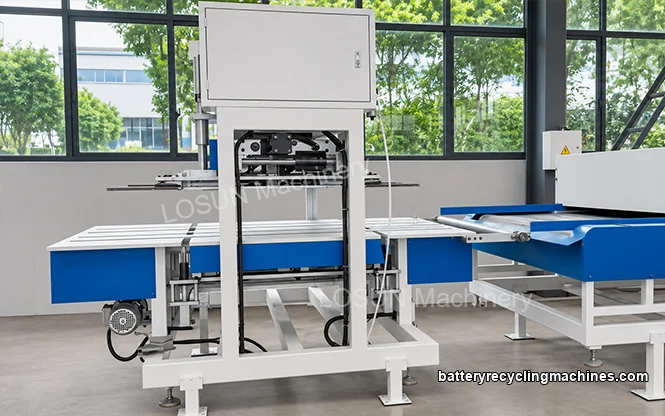
If you are planning to purchase solar panel recycling equipment, one of your first questions is likely: How much does a solar panel recycling machine cost? Below, we provide a detailed cost breakdown across different system configurations.
A complete solar PV recycling line typically consists of an aluminum frame remover, glass stripping machine, pyrolysis furnace, crushing and sorting line, and double-glass separation line. Because single-glass and double-glass solar panels require distinct processing methods, we recommend selecting a dedicated configuration tailored to your module type to ensure high recovery quality. Equipment pricing also varies depending on target throughput capacity.
Single-Glass Solar Panel Recycling Line Price
A complete single-glass recycling line includes an aluminum frame remover, glass removal machine, crushing and sorting line, and a centralized PLC control system. The total investment for a complete single-glass line typically ranges from $58,900 to $135,600 USD.
Solar Panel Frame Remover Price
Aluminum frame removers are compatible with both single-glass and double-glass PV modules. These machines use hydraulic clamping cylinders to strip the perimeter aluminum frames and are available in two automation levels:
Fully Automatic Frame Remover ($29,000 – $45,000 USD): Equipped with an automated feeding conveyor that transports modules into the dismantling station. Infrared sensors detect and align the panel position before hydraulic clamps strip the aluminum frames. Removed frames are automatically discharged via a takeaway conveyor.
Semi-Automatic Frame Remover ($2,500 – $5,300 USD): Requires an operator to manually load the solar panel onto the dismantling table and operate the clamp lifting and deframing controls via the push-button cabinet. Once stripped, the aluminum frames are manually collected and stacked.
Glass Removal Machine Price
After deframing, single-glass modules are conveyed into the glass removal machine. Inside the heating chamber, electric heating elements uniformly warm the glass surface to soften the internal EVA encapsulant layer. The softened panel then passes through dual counter-rotating cutter shafts that shear and strip the glass from the backsheet, discharging separated glass cullet and laminates through dedicated outlets. Pricing typically ranges from $18,400 to $32,800 USD.
Crushing and Sorting Line Price
Once the glass is stripped, the remaining laminate is conveyed into the crushing and sorting line. Through sequential shredding, pulverizing, fine grinding, two-stage vibrating screening, gravity separation, and electrostatic separation, the system recovers pure silicon powder, plastics, and copper granules. Pricing for this sorting line typically ranges from $38,000 to $57,800 USD.
Double-Glass Solar Panel Recycling Line Price
A complete double-glass recycling line comprises an aluminum frame remover, pyrolysis furnace, separation line, and a PLC control system. The total price for a complete double-glass line typically ranges from $73,400 to $142,000 USD.
Double-Glass Pyrolysis Furnace Price
After frame removal, double-glass modules are conveyed into an electrically heated pyrolysis furnace, which thermally decomposes the polymer adhesive sandwiched between the two glass panes to cleanly separate the glass from the silicon wafers. Off-gases generated during thermal decomposition are purified through an integrated exhaust gas treatment system. Pricing typically ranges from $56,000 to $74,000 USD.
Double-Glass Separation Line Price
Post-pyrolysis fragments—consisting of glass pieces, silicon wafer shards, and copper ribbons—are fed via a vibrating feeder into an air classifier for weight-based separation. Heavier glass chunks discharge through the bottom outlet, while the lighter copper ribbons and silicon wafers proceed to an airflow separator for density-based sorting. Pricing for this separation line typically ranges from $14,900 to $23,000 USD.
| Equipment / Line Configuration | Applicable Module Type | Estimated Price Range (USD) |
|---|---|---|
| Complete Single-Glass Recycling Line | Single-glass modules | $58,900-$135,600 |
| Complete Double-Glass Recycling Line | Double-glass modules | $73,400 -$142,000 |
| Fully Automatic Frame Remover | Single- & double-glass | $29,000 - $45,000 |
| Semi-Automatic Frame Remover | Single- & double-glass | $2,500 - $5,300 |
| Glass Removal Machine | Single-glass modules | $18,400-$32,800 |
| Crushing & Sorting Line | Single-glass laminates | $38,000-$57,800 |
| Double-Glass Pyrolysis Furnace | Double-glass modules | $56,000-$74,000 |
| Double-Glass Separation Line | Post-pyrolysis double-glass | $14,900-$23,000 |
03 / FAQ
Frequently Asked Questions (FAQ)
1. What is the exact price of a complete solar panel recycling system?
We must first confirm whether you require a standalone machine, a modular sub-system, or a full turnkey line, along with your feedstock specs, target outputs, and delivery scope. Price figures without these parameters serve only as preliminary reference ranges rather than a finalized procurement budget.
2. Why do quotes for the same rated throughput vary so widely across suppliers?
Always verify whether quoted capacities are benchmarked on identical module types, include the exact same processing stages, and meet comparable output purity standards. Differences in automation levels, environmental/auxiliary systems, and after-sales services also drive significant price variations.
3. Is a smaller-capacity machine always proportionally cheaper?
Lower throughput reduces the size of certain core machines, but electrical controls, safety guarding, and dust/emission control systems do not scale down linearly with capacity. Even small-scale projects must budget for a complete, compliant auxiliary setup.
4. Can published online prices be treated as final purchase quotes?
We recommend verifying exact machine models, quantities, quotation validity dates, and included scope. Published prices often reflect base configurations or specific operating conditions; formal procurement should always rely on a confirmed equipment list and itemized quotation.
5. Can I purchase a partial system first and expand the line later?
Yes, we can engineer a phased expansion plan, provided material transfer interfaces, plant layout, and utility capacities are designed upfront. Costs for future re-installation or structural modifications should also be factored into your long-term budget.
6. Are spare parts included in the quoted equipment price?
Spare parts coverage depends on the agreed scope of supply. We itemize initial spare parts, consumable wear parts, warranty replacements, and recommended future spares separately—clearly defining quantities and responsibilities.
7. What details do I need to provide to receive a formal quotation?
Please share your module types, dimensions, average unit weight, breakage ratio, target hourly/annual capacity, desired end-product specs, project location, and facility conditions. If you have existing upstream or downstream machinery, please provide those interface specifications as well.
8. How can I secure the most cost-effective equipment price?
Lock down your essential scope of supply first, eliminate unnecessary add-ons that offer little practical value, and standardize technical, delivery, and acceptance criteria across vendors. Clearly defined engineering requirements are far more effective at preventing surprise change-order costs than simply negotiating down a lump-sum price.
When you request a quote from LOSUN Machinery, we itemize equipment specifications, engineering interfaces, optional add-ons, and commercial terms separately—giving you complete transparency into both upfront capital expenditure and downstream operating costs.
