
SOLAR PANEL RECYCLING / EQUIPMENT SELECTION
How to Choose a Solar Panel Recycling Machine
Starting from module structure, product specifications, full-line capacity, operating costs, and site conditions, this guide explains how to select solar panel recycling equipment—covering pilot trials, quote comparisons, and procurement acceptance criteria.
Estimated reading time: 6 min
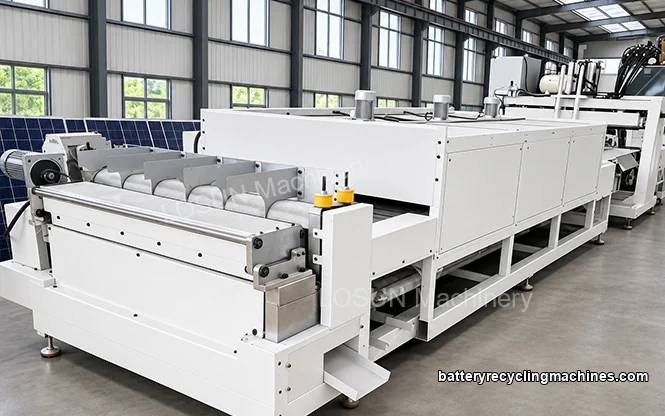
When selecting a solar panel recycling machine, you must first define your feedstock types and target end products before matching them with process technology, throughput capacity, and equipment pricing. For the same panel volume, vendor quotes may cover vastly different scopes—ranging from front-end dismantling and glass removal to complete crushing and material sorting lines. Never evaluate a technical proposal based on price alone.
We recommend following a structured selection sequence:
Identify PV Module Types → Define Equipment Specifications → Select Recycling Process → Calculate Full-Line Capacity → Verify Site & Engineering Conditions → Compare Total Cost of Ownership → Establish Acceptance Criteria.
1. Define Feedstock Types First to Establish Equipment Operating Boundaries
We need to know the dimensions, unit weight, structural design, encapsulant materials, and physical damage conditions of your incoming modules—ideally supported by actual photos and detailed specifications of your end-of-life solar panels.
If your feedstock originates from multiple solar farms or supply channels, document the primary module models and batch ratios separately, and provide representative samples from each source.
| Feedstock Condition | Equipment Requirements We Verify |
|---|---|
| Single-Glass vs. Double-Glass | Support, positioning, delamination, and downstream separation methods |
| Framed vs. Frameless | Deframing station requirements and conveyor compatibility |
| Intact vs. Damaged | Feeding mechanisms, broken glass collection, and clean-out access |
| Dimension & Weight Variations | Effective working envelope and changeover adjustment protocols |
| Encapsulant Variations | Delamination parameters and compatible thermal/mechanical processes |
| Attachments & Contamination | Front-end preparation and allowable impurity thresholds |
"Being able to feed a module into a machine" and "consistently producing on-spec output" are two very different requirements. In our technical proposal, we explicitly define permitted PV module types, operating limits, and categories requiring separate pilot validation.
2. Define Separation Targets Using Downstream Off-Taker Standards
We recommend obtaining product acceptance specifications from your potential off-takers prior to procurement. Equipment configurations should serve commercial delivery requirements rather than merely achieving visually clean separation.
Glass Cullet: Confirm whether you are selling crushed glass cullet, along with exact limits for particle size distribution, polymer residue, metals, and other inclusions. Whether recovered glass qualifies for specific manufacturing applications must be verified through lab testing and buyer approval—never judged solely by visual clarity or color.
Aluminum and Copper-Bearing Materials: Verify acceptable residue levels on stripped aluminum frames, handling methods for cables and junction boxes, and whether mixed metal fractions require secondary sorting. Different physical forms correspond to different buyer acceptance and pricing tiers.
Silicon and Silver-Bearing Materials: Distinguish clearly between material enrichment and refining. Solar cell fragments or fine powders recovered from physical crushing lines may still contain trace amounts of glass, polymers, and other metals; if high-purity output is required, a downstream hydrometallurgical refining route must be added.
3. Compare Processes by Feedstock and End-Product Specs—Not Equipment Count
We never finalize a complete equipment list without evaluating representative samples and end-product specifications first.
| Processing Objective | Key Comparison Criteria |
|---|---|
| Aluminum Frame & Junction Box Removal | Stripping efficiency, module compatibility, and manual assistance needs |
| Glass Cullet Recovery | Surface residue levels, particle size, fines loss, and metallic inclusions |
| Cell & Backsheet Processing | Crushing, liberation, sorting efficiency, mass distribution, and recirculating load |
| High-Purity Material Production | Downstream extraction, purification, and utility/engineering infrastructure |
A longer process line is not automatically better for your project. Every added processing stage must justify which specific product metric it improves, how much material loss it prevents, and what additional capital expenditure (CAPEX) and operating expenditure (OPEX) it introduces. For separated fractions that lack an immediate downstream buyer, we allocate testing and disposal budgets rather than assuming they will automatically generate revenue.
4. Compare Continuous Full-Line Capacity and Standardize Measurement Metrics
Equipment capacities and process designs vary across manufacturers. Because solar panels come in diverse sizes and weights, module variations directly impact actual system throughput.
Consequently, equipment capacity should be benchmarked through timed pilot runs using representative sample panels to establish true operating rates. Annual processing capacity must be calculated based on shift schedules, effective uptime, and average throughput—accounting for routine cleaning, batch changeovers, and scheduled maintenance that reduce net operating hours.
5. Validate Recovery Performance Through Feedstock Pilot Trials
We recommend conducting pilot trials using both standard PV module types and the most challenging feedstocks within your expected receiving range. Testing only intact, uniform panels will not accurately predict line performance when processing mixed incoming batches.
During trials, we log fresh feed input, finished product outputs, recirculated middlings, residues, and internal equipment holdup changes, while taking representative samples from each major stream. Performance is evaluated across three distinct metrics:
Product Mass Yield: The weight of a specific output fraction divided by the agreed input feed weight.
Material Recovery Rate: The percentage of a target material in the feedstock successfully captured in the designated finished product.
Product Purity: The concentration of the target component within the designated finished product.
These three metrics cannot substitute for one another. A high glass mass yield that carries excessive polymer or metal contamination will still fail off-taker acceptance. We require test reports to specify feedstock specs, test duration, weighing points, and assay methods so competing proposals can be compared on an equal footing.
6. Verify Site Conditions and Safety Configurations
Fitting machinery inside a building footprint does not mean the facility is ready for continuous operation.
We check clear ceiling height, column grid spacing, floor load capacity, access doors, power supply, and material logistics—while reserving adequate maintenance clearance for replacing screens, blades, rotors, and wear components. We tailor the equipment layout specifically to your plant conditions.
Safety and environmental controls must match the actual process hazards, including mechanical guarding, electrical hazard protection, cullet containment, dust extraction, and off-gas treatment for thermal stages—configured in accordance with local regulations and engineering assessments.
Automation must also be defined by concrete functional capabilities. Rather than merely confirming the presence of a PLC, verify how the system handles size changeovers, feed rate synchronization, fault alarms, safety interlocks, and post-fault recovery. For operations handling highly variable feedstocks, ergonomic manual-assist stations and operator PPE/guarding must also be integrated into the design.
7. Standardize Scope of Supply Before Comparing CAPEX and OPEX
First, organize vendor quotes into a standardized side-by-side checklist to verify whether conveyors, controls, collection bins, auxiliary systems, shipping, installation supervision, commissioning, and initial spare parts are included.
Operating cost comparisons must account for labor, electricity, wear parts, maintenance, quality testing, and residue disposal. Rated motor kW cannot be used directly to estimate actual power bills; instead, calculate specific energy consumption within a clearly defined system boundary:
Specific Power Consumption = Total System Electricity Consumed During Period / Actual Feedstock Processed During Same Period
If a process route requires secondary washing, drying, or re-sorting, include those expenses in your model. Unplanned downtime frequency, repair times, and spare parts lead times also directly impact overall equipment effectiveness (OEE) and should be evaluated during procurement. Always compare proposals based on the total cost per ton of on-spec finished product to avoid costly add-on stages after purchase.
8. Write Performance Guarantees into the Purchase Agreement
Before placing an order, formalize the following acceptance terms in the contract:
| Acceptance Item | Contractual Terms to Define |
|---|---|
| Feedstock Scope | Module types, dimensions, weights, physical conditions, and allowable impurities |
| Throughput Capacity | Weighing points, continuous test duration, and downtime accounting rules |
| Product Quality | Assay parameters, impurity limits, sampling methods, and re-testing protocols |
| Material Recovery | Target materials, tracked output streams, and recovery calculation formulas |
| Utility Consumption | System boundary, metering points, and measurement period |
| Delivery & Services | Installation interfaces, operator training, warranty terms, and spare parts obligations |
When reviewing manufacturer track records, verify that case studies correspond to actual commercial installations and that equipment lists, site photos, and test results align consistently. Reference configurations and completed commercial projects should always be clearly distinguished.
