
SOLAR PANEL RECYCLING / EQUIPMENT OVERVIEW
What Is a Solar Panel Recycling Machine?
Starting from module structure, we introduce the definition, main equipment, working principles, and processing scope of solar panel recycling machines—explaining the differences between dismantling, delamination, crushing/sorting, and downstream material…
Estimated reading time: 7 min
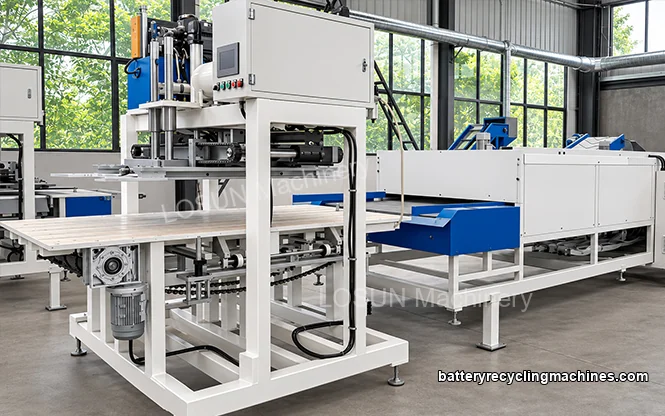
In recent years, end-of-life solar panel recycling machines have gained significant attention as eco-friendly equipment for photovoltaic (PV) module recovery and reuse. Utilizing dry physical-mechanical technology, these systems process decommissioned solar panels efficiently through sequential stages—including frame removal, glass stripping, shredding, pulverizing, and sorting—to extract reusable resources such as copper, aluminum, silicon, and glass. These recovered materials carry substantial economic value, support sustainable energy development, generate financial returns, and enable resource regeneration in an environmentally responsible manner.
1. Which Materials Need to Be Separated from a Solar Panel?
Taking conventional crystalline silicon (c-Si) PV modules as an example, the primary materials processed include glass, aluminum frames, silicon solar cells, copper interconnects, polymer encapsulants (such as EVA), and junction boxes. Different solar panel types vary in structural design, material composition, and bonding methods.
| Module Component | Processing Approach | Resulting Material Stream |
|---|---|---|
| Aluminum Frame | Dismantled and collected separately | Aluminum frames |
| Junction Box & Cables | Detached and processed independently | Junction boxes and cables |
| Glass | Delaminated and stripped | Crushed glass cullet |
| Solar Cells | Crushed and sorted | Silicon-, silver-, and metal-bearing fractions |
| Interconnects | Crushed and gravity-separated | Tin-coated copper granules |
| Encapsulant & Backsheet | Separated and routed by end-use | Polymers or mixed residues |
2. Why Do Solar Panels Require Specialized Recycling Equipment?
The glass, solar cells, and encapsulant layers in a solar panel are tightly bonded through lamination. Standard disassembly only removes external components (via junction box removers and deframing machines) and cannot separate the internal layers of the laminate.
Shredding an entire solar panel directly reduces its size, but it also mixes glass, metals, silicon, and polymers into similar particle size fractions—dramatically increasing downstream separation difficulty. Therefore, the sequence of dismantling and liberation must be selected based on your target end products to prevent cross-contamination.
For instance, if you aim to recover relatively intact glass, we prioritize evaluating module integrity and interfacial separation methods. If crushed cullet is acceptable, we focus on controlling impurity levels, particle size distribution, and fine powder losses. These two objectives require distinct equipment configurations and acceptance criteria.
3. How Does a Solar Panel Recycling Machine Work?
We typically divide the solar panel recycling workflow into four stages. Exact processing steps are tailored to the specific panel type and technical route, as single-glass and double-glass modules require markedly different recycling processes.
1. Sorting and Dismantling
We first verify panel type, dimensions, damage condition, and attachments, sorting modules according to acceptance standards. Front-end equipment positions the module and uses an automated aluminum frame remover and junction box remover to strip away external hardware, reducing non-target materials in downstream stages. For frameless, deformed, or severely shattered panels, feeding and support mechanisms are evaluated separately.
2. Glass Separation
We break the bond between the glass and the encapsulant using tailored mechanical, glass-crushing, pyrolysis, or hybrid processes:
Single-Glass Solar Panels: Processed using a solar panel glass removal machine. Inside a heating chamber, heating elements uniformly warm the glass to soften the internal EVA encapsulant layer. Once softened, precision blades shear and strip the glass from the backsheet, completing glass-backsheet separation.
Double-Glass Solar Panels: Conveyed into a pyrolysis furnace, where controlled thermal decomposition breaks down the adhesive encapsulant sandwiched between the two glass panes, separating the glass from the silicon wafers.
3. Crushing, Liberation, and Sorting
For laminates requiring further processing, we configure size-reduction, liberation, screening, and physical separation machinery based on pilot testing:
Single-Glass Solar Panels: The remaining laminate is fed into a shredder to be reduced into 2–3 cm pieces, then pulverized into powder by a high-speed grinder. A primary vibrating screen sifts out a portion of silicon powder, while the remaining mixture undergoes secondary fine grinding. A second vibrating screen separates plastics and rubbery polymers. Next, a gravity separator extracts copper granules, and an electrostatic separator divides the remaining fine powder into silicon powder and plastic powder. High-efficiency pulse-jet dust collectors operate throughout the line to purify airborne particulates.
Double-Glass Solar Panels: Post-pyrolysis output consists of silicon wafers, copper ribbons, and glass fragments. A vibrating feeder delivers the mixture into an air classifier, where heavier glass pieces discharge from the bottom outlet, and the remaining copper ribbons and silicon wafers are separated via airflow sorting to yield distinct material fractions.
4. Classified Collection and Testing
Glass, aluminum frames, silicon powder, metal granules, and plastics are collected in dedicated bins. Finished outputs are weighed and analyzed with specialized testing instruments to verify purity and composition before sale to downstream buyers.
4. What Equipment Is Typically Included in a Complete System?
We modularize solar panel recycling lines around specific process tasks to deliver customized solutions tailored to each client's operational needs.
| Equipment Unit | Primary Function |
|---|---|
| Feeding & Conveying System | Module positioning, transfer, and inter-station synchronization |
| Aluminum Frame Remover | Automated stripping of perimeter aluminum frames |
| Junction Box Remover | Detachment of junction boxes and attached cabling |
| Glass Removal Machine | Separation of front glass from polymer/backsheet layers |
| Pyrolysis Furnace | Thermal decomposition of adhesives in double-glass modules |
| Crushing & Liberation Units | Size reduction and mechanical liberation of composite laminates |
| Multi-Stage Sorting System | Physical classification by size, density, and conductivity |
| Collection & Dust Control System | Finished product collection and emissions/dust filtration |
| Electrical Control System | Automated process coordination, monitoring, and safety interlocks |
If you only require front-end dismantling, we can configure standalone machines or partial lines around those specific tasks. If your goal is multi-material recovery, downstream sorting and product collection boundaries must be defined accordingly.
5. Can Mechanical Equipment Directly Produce Pure Silicon and Silver?
Mechanical processing primarily accomplishes dismantling, liberation, and material enrichment. It is critical to distinguish between producing silicon- or silver-bearing concentrates and obtaining refined silicon or silver that meets industrial purity specifications.
After mechanical sorting, silicon, electrode metals, solder alloys, and trace polymers may still retain varying degrees of cross-contamination. Achieving high-purity metals or solar-grade silicon requires downstream hydrometallurgical extraction, chemical leaching, or refining processes. Accordingly, our technical documentation specifies exact output morphologies and assay ranges rather than misrepresenting mechanical sorting as full refining capability.
6. Which Module Types Require Separate Validation?
Single-Glass vs. Double-Glass Modules: We inspect backsheet construction, glass layer count, encapsulant chemistry, and breakage levels separately. Both architectures require distinct machinery and process routes.
Intact vs. Damaged Modules: For intact modules, we verify automated dismantling and delamination compatibility. For broken modules, we must also engineer fragment support, steady feeding, clean-out access, and fines collection. Test results from intact panels cannot be extrapolated directly to shattered feedstock.
Crystalline Silicon vs. Thin-Film Modules: We evaluate each technology by its material chemistry. Thin-film modules contain different semiconductor compounds and layer structures and cannot be fed directly into a crystalline silicon line simply because they share a similar external form factor.
7. How Do We Evaluate Actual Equipment Performance?
We evaluate system performance across three simultaneous metrics: throughput capacity, product quality, and material mass balance.
Throughput Capacity: The quantity of specified feedstock processed per unit of time.
Product Purity: The concentration of the target component within a given output stream.
Material Recovery Rate: The percentage of total target material in the input feedstock successfully captured in the designated finished product.
These three metrics cannot substitute for one another. High hourly panel counts will still fail project requirements if accompanied by excessive glass contamination or metal losses. During acceptance trials, we define exact feedstock specs, test duration, weighing points, sampling protocols, and internal machine holdup changes—while logging power, labor, and maintenance metrics to confirm suitability for continuous industrial operation.
08 / FAQ
Frequently Asked Questions (FAQ)
Is a solar panel recycling machine just a shredder?
No. We treat a shredder as just one unit operation within certain process routes. A complete recycling workflow typically encompasses sorting, dismantling, delamination, multi-stage separation, and dust-controlled collection.
Can the machine recover 100% of all module materials?
Each material stream must be accounted for based on the specific process route. Separating a material fraction does not automatically mean it meets commercial resale or high-value specifications, nor can any system guarantee 100% material recovery.
Can one equipment line process all panel sizes and models?
We specify allowable ranges for module dimensions, weights, structures, and physical conditions in the technical agreement. Modules outside these parameters require engineering review or dedicated pilot testing.
What information should I prepare before inquiring about equipment?
Please provide your module types, photos, dimensions, unit weights, breakage ratio, projected processing capacity, and target end products. We use this data to define the required process tasks before recommending an equipment configuration.
At LOSUN Machinery, we anchor every proposal in feedstock compatibility and end-product specifications—clearly defining the role of each machine and identifying any fractions requiring downstream refining—to help you establish a practical, cost-effective procurement scope.
